


Moterra Claude Partner Network - Select Services Partner
Pricing About us
Get a quote
← All writing
Security and compliance

Claude Cowork for business: enterprise deployment in your own cloud

Amanda Uzialaite Amanda Uzialaite 27 August 2026 Updated 27 September 2026 14 min read
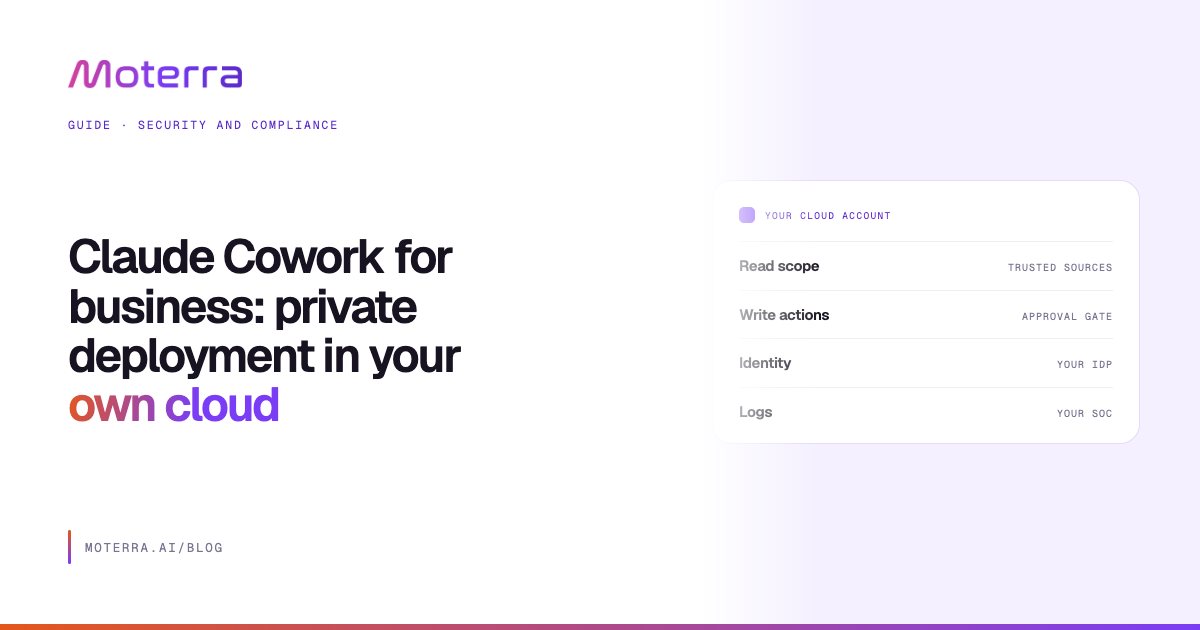
Private Claude by Moterra: read scope, write approval gates, identity and logs inside your own cloud account

Since April 2026, Claude Cowork can run against model endpoints in your own cloud rather than Anthropic's. That one change decides whether a regulated business can sign it off.

Anthropic's guidance on using Cowork safely is clear and worth reading, but it is written for one person on a Pro plan. If you are deciding whether agentic AI enters a 200 person regulated business, you need the next layer: where inference runs, what your auditor sees, who sets the rules the agent operates under, and how the rollout survives procurement.

This guide covers that layer, and how Moterra builds it.

Quick answer

Claude Cowork for business runs on Amazon Bedrock or Microsoft Foundry inside your own cloud tenant, configured through a managed settings file your MDM pushes to every laptop. Four settings define the deployment: the inference route, the MCP connector allowlist, the organisation plugins, and the managed configuration that carries them. Moterra deploys this in your AWS or Azure account in one to two weeks, with prompts and files never leaving your tenant and no model training on your data.

What changed for Claude Cowork in April 2026?

In April 2026 Anthropic documented Claude Cowork and Claude Desktop running against third-party inference: Amazon Bedrock, Google Cloud Vertex AI, Microsoft Foundry, or a gateway you operate. Same app, same interface, with the model call landing in an endpoint you control.

It reads like a configuration detail. In practice it moves four boundaries from Anthropic's perimeter into yours:

Inference boundary The model call lands in your account, in the region you choose.
Audit boundary Requests are logged in CloudTrail or Azure Monitor, next to everything else your SOC already watches.
Cost boundary Consumption bills to your existing cloud account and counts against committed spend.
Data boundary Your key, network and data loss prevention policies apply to AI traffic like any other production system.

The mechanics of the route itself are covered in our guide to Claude Desktop on third-party platforms. The rest of this page is about the deployment around it.

What does Claude Cowork actually do?

Cowork gives Claude the ability to act, not just answer. It reads files, browses the web, runs code, and works inside your connected applications.

Anthropic groups those capabilities in two:

Read tools Claude sees things: a document, an inbox, a database result, a report.
Write tools Claude does things: sends an email, updates a record, runs a command, submits a form.

Read capability is where most of the day-to-day value sits. Write capability is where the leverage is, and where governance earns its place. A business deployment should let you tune both, per workflow, rather than accept a single default.

What does an enterprise Cowork deployment control?

Every enterprise deployment comes down to four settings. Get them right and the rest is operational detail.

01 Inference route Which provider endpoint, region and model the app calls. It decides where data is processed, whose logs record it and whose invoice it lands on. Owner · Platform engineering and finance
02 Connector allowlist Which MCP servers the app may load. A connector into your CRM or document store is a path for data, so each one is a governance decision rather than an install. It is the line of policy your security team should review first. Owner · Security architecture
03 Organisation plugins The approved skills, prompts and integrations pushed to every device and managed centrally. Retiring one is a change to the profile, not a request to every user. Owner · Security operations
04 Managed configuration The settings file your MDM (Jamf, Microsoft Intune or Group Policy) pushes to each device. It carries the other three plus file, network and telemetry scope. Keep it in version control and review changes like firewall rules; it is the artefact an auditor asks to see. Owner · Endpoint engineering

The route comes first, because the other three follow from it.

Bedrock, Azure or Vertex: which route fits Claude Cowork?

Every route delivers the same Claude models. They differ in the identity you authenticate with, where logs land, and which contract already covers you.

Amazon BedrockMoterra deploys
IdentityIAM roles, short-lived credentials Audit trailAWS CloudTrail Best fitAWS-first organisations with IAM, billing and SIEM already wired Watch forFailover stays inside AWS regions
Microsoft Foundry on AzureMoterra deploys
IdentityMicrosoft Entra ID, Conditional Access Audit trailAzure Monitor, Microsoft Sentinel, Purview Best fitMicrosoft 365 organisations Watch forNew models can reach Foundry later than other routes
Google Cloud Vertex AI
IdentityService accounts, Workload Identity Audit trailCloud Audit Logs Best fitGoogle Cloud-first organisations Watch forMoterra deploys into AWS and Azure
Anthropic direct
IdentityAnthropic account and API key Audit trailAnthropic console Best fitPilots with no residency requirement Watch forData is processed on Anthropic infrastructure
Self-hosted gateway
IdentityYour identity provider in front of any route Audit trailYour SIEM Best fitMulti-provider estates that want one audit pane Watch forYou run, patch and staff it

The deciding question is rarely technical. It is which perimeter you already operate. An AWS-first business gets identity, logging, billing and procurement that are already approved. A Microsoft-first business gets the same through Entra and Sentinel. Moterra deploys into either with the same architecture.

What does a private deployment give you?

A private Claude deployment in your own cloud gives you the five things a regulated business needs before rollout.

What you need What you get
Data residency Prompts, files and outputs processed in your own cloud tenant, in your chosen region
Audit evidence Logs are yours. You answer a regulator directly, without a vendor request
Access control Connectors inherit the permissions already in place. No new logins, no new SSO maps
Network control Private endpoints, your own KMS keys, AES-256 at rest and TLS 1.3 in transit
Contractual simplicity Moterra operates as a data processor under a DPA covering UK GDPR and EU GDPR

This is the foundation. On top of it sits configuration, and that is the part most deployments skip.

How do you govern what an agent reads and does?

By setting a trust boundary and enforcing it in the deployment rather than in a user settings menu.

Anthropic makes a useful point about agent risk: consequential mistakes need two conditions present together. The agent can read content from outside your trusted sources, and the agent can take an action that matters. Narrow either one and the risk drops sharply.

That is a design instruction, and it is straightforward to act on:

01 Document the trust boundary Which systems, mailboxes and sites are trusted sources. Which are not.
02 Broad read, deliberate write Most valuable agent work is reading and synthesising. Write access is granted per workflow.
03 Approval gates on consequential actions Sending, publishing, paying, deleting. Set as policy, not per user.
04 Scheduled work gets its own permissions Unattended tasks run without a human present, so they get a tighter scope by default.
05 Logs into your existing SOC Activity your security team already monitors, in the tool they already use.
06 Connectors vetted like production software A connector with write access to your CRM is exactly that.
07 One department, one workflow first Prove the pattern, then extend it.

Moterra AI Bridge is the layer that makes these enforceable: admin console, MDM profiles, plugin management and agent controls around Cowork.

How do you roll Claude Cowork out across the business?

Start narrow, instrument early, and test the controls before procurement asks. Moterra has the first group live in one to two weeks; the full fleet follows in three phases over roughly ninety days, each with a proof point and a drill.

Weeks 1-2 · Pilot
GoalDeploy into your tenant, draft the managed configuration with a short connector allowlist, go live with one department and one workflow ProofA request appears in CloudTrail or Azure Monitor with a known user identity DrillChange a setting in the profile and confirm every pilot device picks it up on the next MDM sync
Weeks 3-8 · Expand
GoalExtend to more teams, feed logs into your SIEM, use the usage dashboard for adoption, cost and time saved ProofA security analyst, not the platform team, can answer who used Claude this morning in minutes DrillRetire a plugin or connector in the profile and time how long the fleet takes to drop it
Weeks 9-12 · Fleet
GoalRoll out to the remaining devices, write the data residency position down, produce the review summary ProofCompliance can hand an external auditor a one-page summary without preparing DrillMake the model endpoint unreachable for a test group and confirm users see a clear error and service recovers

Grow the connector allowlist by request, not by guess: each addition gets a ticket, an owner and a review date. And run the drills before sign-off. A reviewer will ask, and "we plan to" is not an answer.

What goes in the one-page review summary?

A defensible deployment fits on one page that security, procurement and audit can sign off in the same week. It names:

Inference route Provider, region and model, and the contract that covers them.
Identity The authentication method and identity provider behind it, including how a leaver is removed.
Audit trail Where logs land, who can read them and how long they are kept.
Connector allowlist What is approved, and the change process for adding more.
Plugins The approved set and the owner of each one.
Data residency In plain language: where data is processed, what the configuration enforces and what evidence proves it.

A reviewer is testing four things: what is enforced, what is logged, how configuration changes, and what happens when something fails. A deployment that cannot answer those in writing is not finished, however many seats are running.

How does private Claude Cowork compare with ChatGPT Enterprise and Microsoft Copilot?

Most evaluations run in parallel. The difference that matters is the deployment model, not the feature list.

QuestionPrivate Claude by MoterraHosted assistants
Where inference runs Your AWS or Azure tenant, in your region The vendor's cloud; for Copilot, the Microsoft 365 service boundary
Who holds the logs You, in CloudTrail or Azure Monitor The vendor's admin console and export tools
Encryption keys Your own KMS keys Vendor-managed by default
Connector control Allowlist in your MDM profile Vendor catalogue and admin settings
Pricing Cloud consumption plus a managed service, no seat licence Per seat, per month

Hosted assistants ask for less configuration and give you less control. A private deployment asks for more configuration, and Moterra does that part. The quote configurator sets Year 1 cost side by side with the Enterprise editions of Claude, ChatGPT and Microsoft 365 Copilot.

Should you build it yourself or deploy with Moterra?

The route is a day of work. The layer around it is the project.

What it takesWith MoterraBuild it yourself
Cloud environment and region Deployed into your AWS or Azure account, in your region Designed and hardened by your platform team
Managed configuration Authored, version-pinned and pushed through your MDM Written from scratch, tested per OS, re-tested per app update
Connectors and MCP plugins SharePoint, Teams, Salesforce, Slack, Jira and Google Workspace, inheriting existing permissions Built and security-reviewed one by one
Identity Your existing identity provider, no new SSO maps Mapped by hand
Adoption reporting Usage dashboard for adoption, cost and time saved from day one Built on raw logs
Time to the first users One to two weeks Three to six months

How does Moterra deploy Private Claude Cowork?

Private Claude by Moterra runs inside your own AWS or Azure tenant. Same Anthropic product, same models, same interface. What changes is where it runs.

Your data, prompts and files stay in your tenant. Encrypted with AES-256 at rest and TLS 1.3 in transit, accessed through private endpoints with your own KMS keys.
Models delivered via AWS Bedrock or Azure AI Foundry. No data flows back to Anthropic and nothing reaches any training pipeline. Guaranteed by architecture, not policy.
Connectors to SharePoint, Teams, Salesforce, Slack, Jira and Google Workspace read and write while inheriting the permissions already in place. No new logins, no new SSO maps.
Moterra operates strictly as a data processor under a DPA meeting UK GDPR and EU GDPR.
Live in one to two weeks, with a usage dashboard tracking adoption, cost and time saved from day one.

Moterra is a Select Services Partner in the Claude Partner Network and an AWS Partner with GenAI Competency. AWS customers can procure through AWS Marketplace and consolidate with existing AWS spend and committed-use credits.

ISO 27001 and ISO 42001 certified across both the AWS and Anthropic layers, so the deployment stack is certified end to end. AWS and Anthropic hold SOC 2 Type II reports, and Moterra’s setup has been independently validated by cyber security specialists. Your deployment is defensible under UK GDPR, EU GDPR, EU DORA and UK operational resilience requirements.

What does this look like in practice?

Ask your SharePoint and your operations database a question in plain English. Get an answer that cites its sources. The answer never leaves your cloud account.

That is the demo, and it runs on your systems, not a sandbox. Most teams reaching this page have already tried a general purpose assistant and found it could not see their actual data. The pattern is rarely about the model.

In a live deployment: Skaylink, a Vodafone group company, reached 80% team adoption within a week of go-live and cut the time their NIS2 audit process takes by 90% with a Claude-powered audit tool built on the Moterra platform. More in the case studies.

Pricing follows the deployment: you pay your cloud provider for consumption and Moterra for the managed service, with no seat licence in between. The quote configurator prices users, support tier and plugins in the open, so you can take a number to finance before you talk to us.

Get a quote or book a call to see it running in your environment.

Frequently asked questions

Is Claude Cowork safe to use with confidential business data?

In a private deployment, yes. Your data, prompts and files never leave your cloud tenant. Encryption uses AES-256 at rest and TLS 1.3 in transit, through private endpoints with your own KMS keys, and connectors inherit the access permissions already in place rather than creating new ones.

Can Claude Cowork run on Amazon Bedrock?

Yes. Since April 2026 Anthropic documents Claude Cowork running against third-party inference, including Amazon Bedrock. A managed settings file points the app at Bedrock in your own AWS account, authentication uses IAM, requests are logged in CloudTrail and consumption bills to your AWS account. Moterra deploys this, and AWS customers can procure through AWS Marketplace against committed spend.

Can Claude Cowork run in Azure rather than AWS?

Yes. Moterra deploys the same architecture in Azure, with Claude models delivered through Microsoft Foundry inside your own tenant, identity through Microsoft Entra ID and logs in Azure Monitor and Microsoft Sentinel.

Can Claude Cowork run on Google Cloud Vertex AI?

Vertex AI is one of the third-party routes Anthropic documents. Moterra deploys into AWS and Azure; if your estate is Google Cloud first, raise it on the first call.

Where is Cowork data processed?

In a Moterra deployment, inside your own AWS or Azure environment, in the region you select. Anthropic's standard product runs sessions on Anthropic's infrastructure.

Will our data be used to train Claude?

No. Models are delivered via AWS Bedrock or Azure AI Foundry inside your own tenant, with no data flowing back to Anthropic. Your prompts, files and outputs never reach a training pipeline. This is guaranteed by architecture, not policy.

What is the MCP connector allowlist?

It is the list, held in the managed configuration, of MCP servers the app is permitted to load. Each connector is a path into a system such as your CRM or document store, so the allowlist turns connecting a tool into a governance decision. It is the first line of policy a security team should review.

How is Claude Cowork managed across a fleet of laptops?

Through a managed settings file pushed by your MDM, such as Jamf, Microsoft Intune or Group Policy. It sets the inference route, region and model, the connector allowlist and the organisation plugins. Moterra authors, version-pins and pushes it through your existing MDM.

Does Claude Cowork meet GDPR and DORA requirements?

Your deployment is defensible end to end under UK GDPR, EU GDPR, EU DORA and UK operational resilience requirements. The stack is ISO 27001 and ISO 42001 certified across the AWS and Anthropic layers, and Moterra operates as a data processor under a DPA covering both UK and EU GDPR.

How do you control what the agent is allowed to do?

Read scopes and write permissions are configured per workflow, with approval gates on consequential actions such as sending, publishing or deleting. Agent identity comes from your existing identity provider, so permissions follow your existing joiner and leaver process.

What is the difference between this and the Claude Cowork my team already uses?

It is the same Anthropic product, running privately in your cloud. Same models, same interface, same capabilities. What changes is where it runs: your AWS or Azure tenant, your encryption keys, your governance.

How does private Claude Cowork compare with ChatGPT Enterprise or Microsoft Copilot?

The difference is the deployment model. Hosted assistants run inference and hold logs in the vendor's cloud and are priced per seat. Private Claude by Moterra runs in your own AWS or Azure tenant, logs to your own audit trail, uses your keys and is priced as cloud consumption plus a managed service.

How long does deployment take?

Standard deployment is typically live within one to two weeks, starting with one department and one workflow. A full fleet rollout with SIEM integration and review documentation usually follows over about ninety days. Doing it yourself usually takes three to six months across MDM setup, identity integration, MCP plugin development and admin tooling.


Next step

See Cowork answer a question from your own SharePoint.

Bring the hardest questions to the first call. Thirty minutes with a specialist, and a quote for your environment.

Get a quote See the deployment →
Amanda Uzialaite Amanda Uzialaite CMO at Moterra. Writes about deploying AI inside regulated companies.

Sources

Latest writing

All articles →
AI deployment Claude Cowork on 3P vs Claude Enterprise: what is the difference? One runs on Anthropic servers, one inside your own AWS. The difference decides whether your security team can sign it off. Security and compliance Adopting AI in UK legal practice: preserving attorney-client privilege Competitive pressure demands AI adoption, yet professional duty demands privilege. How private infrastructure resolves it. AI deployment AI map simplified: understanding AI, ML, DL and GenAI What sits inside what, in plain language, for people making a decision rather than building a model.
Moterra Claude Partner Network - Select Services Partner

Moterra is a private AI deployment company and a Select Services Partner in the Claude Partner Network. We help businesses deploy Claude inside their own AWS or Azure environment, connect it to the tools they already use, and keep it secure and governed, so everyday processes get faster.

ISO 27001 / 42001 SOC 2 Type II GDPR · DORA
© 2026 Moterra. All rights reserved. Privacy PolicyTerms and Conditions
Build your Private Claude Cowork plan. Pick users, support, and MCP plugins. We show the monthly cost, Year 1 TCO, and how it compares to Enterprise editions of Claude, ChatGPT and M365 Copilot. Get this quote straight to your inbox when you are done.
01 Users Everyone who gets Claude Cowork and Code.
{{ usersLabel }}
5500+
02 Support Standard is included in every plan.
{{ pTierNote }}
03 MCP plugins Optional. 4 or more get 20% off the plugin total.
04 Commitment A term waives the one-time setup fee.
{{ pTermNote }} Setup {{ pSetupTag }}
Your quote {{ monthlyHeadline }} {{ effectiveLine }}
{{ managedLabel }} {{ managedPrice }} Priority support {{ supportPrice }} {{ pluginsLabel }} {{ pluginsPrice }} Monthly recurring {{ monthlyTotal }} Infrastructure costs + tokens (via AWS/Azure), est. {{ awsPrice }} One-time setup {{ setupPrice }} Year 1 total {{ yearOneTotal }}
Vs. alternatives · all-in per user / month · est.
Private Claude by Moterra {{ effectivePerUser }} {{ moterraBasis }} {{ moterraCatch }}
Claude Enterprise {{ claudePrice }} {{ claudeSaving }} {{ claudeBasis }}
ChatGPT Enterprise {{ gptPrice }} {{ gptSaving }} {{ gptBasis }}
M365 Copilot Enterprise {{ copilotPrice }} {{ copilotSaving }} {{ copilotBasis }}

Indicative figures. Moterra includes private deployment in your own AWS; others are shared-cloud SaaS. Final quote confirmed in writing by your Moterra account manager.

Book a demo

Thirty minutes, and the hardest questions first.

Tell us where you are and a Moterra specialist will confirm a time within one working day.

Goes straight to your sales team · no marketing list · no follow-up sequence

✓

{{ qfInboxText }}

Get your quote by email

We'll send it to you and loop in our team.

Turnstile
Verification failed, please reload the page and try again. Please fill in company, name and work email. Something went wrong. Please try again or email sales@moterra.ai directly.
✓

{{ qfSalesDoneText }}

Talk to sales

Leave your details and we'll reach out with your exact setup already in hand.

Turnstile
Verification failed, please reload the page and try again. Please fill in company, name and work email. Something went wrong. Please try again or email sales@moterra.ai directly.