
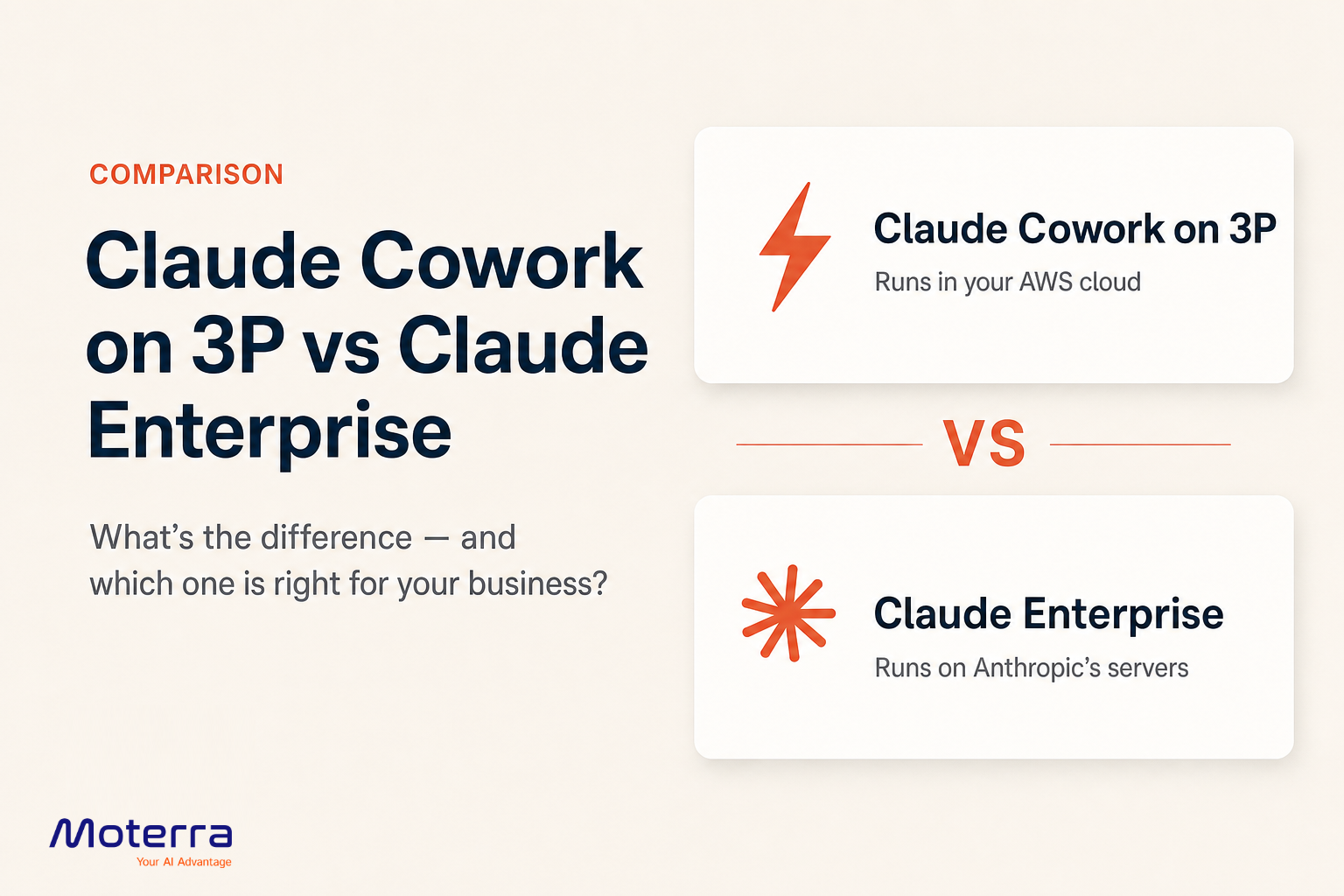
Your employees are already using Claude. According to IBM Security research, 73% of employees admit to entering confidential data into public AI tools - and Claude is one of the most widely used. At some point, every IT manager and CTO faces the same question: how do we make this official, secure, and compliant?
Anthropic offers two paths for businesses: Claude Enterprise and Claude Cowork on 3P. Both give your team access to Claude. But they are architecturally different products, and that difference matters enormously if you operate in a regulated industry, handle sensitive client data, or need your IT team to stay in control.
This post explains both options clearly - including what "on 3P" actually means, what features you gain and what you give up - so you can make the right decision for your organisation.
First, what exactly is Claude Cowork?
Claude Cowork is Anthropic's AI productivity workspace for knowledge workers. Think of it as a desktop-grade AI environment where employees can work with files, automate repetitive tasks, run multi-step research, process documents, and interact with business tools - all through a single interface powered by Claude.
It goes well beyond a simple chat window. Cowork supports Projects, Artifacts, Memory, file uploads and exports, remote connectors, Skills, Plugins, and MCP servers. For knowledge workers in finance, legal, logistics, or professional services, it is a genuinely powerful productivity layer.
The question is not whether your team should use it. The question is how it runs - and who controls the infrastructure underneath it.
What does "on 3P" mean?
This is the most important concept to understand, and it is often misunderstood.
"3P" is Anthropic's technical term for Third Party. It refers to the cloud infrastructure on which model inference runs.
By default, standard Claude Cowork runs on Anthropic's own servers - what Anthropic calls "1P" (first party). Your employees log in, use the product, and all inference flows through Anthropic's infrastructure.
"On 3P" means Claude Cowork routes all model inference through a third-party cloud provider - specifically, your company's own AWS environment via Amazon Bedrock (or alternatively Vertex AI or Azure). Users download the standard Claude Desktop application - the same interface they already know. Your IT or MDM system (Jamf, Microsoft Intune, Group Policy) then pushes a configuration file to Claude Desktop that activates 3P inference mode, specifying the model ID, Amazon Bedrock Inference Profile, authentication method, and organisational policies.
The Claude model is identical. The Cowork interface is identical. But the compute and data processing happen inside your AWS account, not Anthropic's. According to the official AWS announcement, Amazon Bedrock does not store prompts, files, tool inputs and outputs, or model responses, and does not use them to train foundation models - this is a technical guarantee, not a policy promise.
One important nuance on telemetry: Anthropic does receive aggregate telemetry - token counts, model ID, error codes, and an anonymous device identifier. This is not conversation content, but it is not zero data either. It can be disabled through configuration if required.
Pricing is consumption-based through your existing AWS agreement, with no seat licensing fee from Anthropic. This is a key differentiator versus Claude Enterprise.
What features are available, and what is not?
This is where honesty matters. Claude Cowork on 3P does not include every feature of the standard Cowork product. Three features require Anthropic-hosted inference and are not available on 3P:
Chat tab - not available
Computer Use - not available
Skills Marketplace - not available
Everything else works fully: Projects, Artifacts, Memory, file upload and export, remote connectors, custom Skills, Plugins, and MCP servers. For most business use cases - document analysis, research, report generation, workflow automation - the available feature set is comprehensive.
If your team specifically needs Computer Use or the Skills Marketplace, Claude Enterprise is the right choice. If your priority is data sovereignty and AWS-native infrastructure, the 3P trade-off is worth it.
What is Claude Enterprise?
Claude Enterprise is Anthropic's official enterprise subscription tier. It offers significantly higher usage limits, an admin console for user management, SSO integration, priority support, and the full Cowork feature set including Chat tab, Computer Use, and the Skills Marketplace.
For many teams, Claude Enterprise is a practical and fast solution. You sign up, provision users, and your team is working within hours.
The important caveat: Claude Enterprise still runs on Anthropic's servers. Your data goes to Anthropic's infrastructure. Anthropic's policy states that Enterprise data is not used for training - but this is a contractual and policy-based commitment, not a technical one. The data does leave your environment.
For teams without strict compliance requirements, that is often acceptable. For regulated industries, it frequently is not.
Claude Cowork on 3P vs Claude Enterprise: side-by-side
Which one is right for your business?
Choose Claude Enterprise if: you need the Chat tab or Computer Use features, want immediate self-service setup, have a smaller team, or operate in a less compliance-sensitive environment. It is the faster, simpler path with the full feature set.
Choose Claude Cowork on 3P if: GDPR compliance or data residency is non-negotiable, you operate in a regulated industry such as financial services, legal, or healthcare, your IT team needs full MDM control and audit trails, you want AWS billing consolidation, you want Claude connected to your internal systems via MCP business integrations, or shadow AI is already a concern in your organisation.
The trade-off is clear: 3P gives you data sovereignty and AWS-native infrastructure - technical guarantees rather than policy promises - but you lose the Chat tab, Computer Use, and the Skills Marketplace. For most regulated business use cases, that is a trade-off worth making.
Consider both if: you are a larger organisation where different teams have different risk profiles. A marketing team may be well-served by Claude Enterprise, while your legal or finance teams require the data sovereignty of the 3P deployment.
How Moterra deploys Claude Cowork on 3P
Moterra is an AWS-certified partner specialising in private Claude deployments for businesses across Europe. When you work with Moterra, we handle the full deployment: AWS Bedrock environment setup, MDM configuration so IT has central control from day one, MCP plugin installation to connect Claude to your SharePoint, databases, and workflows, user onboarding, and ongoing management and support.
Most organisations are live in under a week. There is no internal IT project to manage and no six-month rollout.
The results speak for themselves. Skaylink, a Vodafone group company, achieved 80% team adoption within one week of deployment and reduced their NIS2 audit process time by 90% using a custom Claude-powered audit tool built on the Moterra platform. Across the market, Salesforce and Anthropic's 2026 research found that employees using Claude save an average of 97 minutes per week. And according to Anthropic, 70% of Fortune 100 companies already use Claude - the question is whether they are doing it with or without IT control.
Conclusion
Claude Cowork on 3P and Claude Enterprise are not competing products - they are different architectural choices for different business contexts. If compliance, data sovereignty, and IT control matter to your organisation, the 3P deployment model provides a technical guarantee that Amazon Bedrock does not store or train on your data - something no policy document can match. If speed, simplicity, and the full feature set are the priority, Claude Enterprise is a solid starting point.
The right question to ask is not "which is better?" but "which is right for our risk profile, our industry, and our team?"