
Executive Summary
UK solicitors face an unprecedented dilemma: competitive pressure demands AI adoption for efficiency and client service, yet professional obligations to protect attorney-client privilege appear fundamentally incompatible with cloud-based AI platforms. This white paper addresses how law firms can resolve this tension through secure infrastructure deployment that keeps sensitive client data entirely within firm control.
Public AI tools like ChatGPT, Claude, and Copilot operate on multi-tenant architectures where client communications become training data for models serving competitors and the public. For solicitors bound by SRA obligations and GDPR requirements, this creates unacceptable risk. The solution lies in deploying AI correctly: through private infrastructure where models run exclusively on firm-controlled servers, data never leaves the organisation, and encryption keys remain in client hands.
This paper examines why public AI fails solicitors’ needs, what UK firms require, and how secure deployment delivers practical benefits—from instant access to institutional knowledge to template-based drafting—whilst maintaining absolute confidentiality.
The Legal AI Dilemma
The legal profession stands at a technological crossroads. Solicitors report spending 23% of billable time on tasks AI could automate—legal research, document review, precedent identification, and drafting. Yet the 2024 Law Society Practice Management Survey found 67% of UK firms feel “significant pressure” to adopt AI technologies, whilst only 19% have implemented any AI tools beyond basic document automation.
This gap reflects genuine professional conflict. Solicitors operate under stringent confidentiality obligations: SRA Principles require protection of client information, common law imposes absolute attorney-client privilege, and GDPR mandates data protection by design. These aren’t compliance boxes to tick—they’re foundational to the solicitor-client relationship and the administration of justice itself.
The dilemma intensifies because AI tools generating headlines—ChatGPT, Claude, Copilot, Gemini—all operate on fundamentally incompatible architectures. These platforms use multi-tenant cloud infrastructure where your client’s confidential settlement negotiation might inform responses to other users’ queries. Their terms of service typically claim broad rights to process, analyse, and learn from submitted content.
The SRA’s 2023 guidance on technology emphasises that solicitors remain “personally accountable” for work product regardless of AI involvement, must ensure AI systems don’t compromise confidentiality, and cannot delegate professional judgment to automated systems. The guidance specifically warns against “uploading client data to external AI platforms without appropriate safeguards.”
Meanwhile, competitive pressure builds. US law firms aggressively market AI capabilities. In-house legal teams deploy AI tools and expect external counsel to match their efficiency. The profession risks bifurcation: firms that compromise confidentiality to adopt AI, and firms that maintain ethical standards whilst losing competitive ground.
Why Public AI Tools Fail Solicitors
Public AI platforms present fundamental problems that make them unsuitable for solicitors handling confidential client matters.
Multi-Tenant Architecture and Training Data Contamination
Public AI services run on shared infrastructure where multiple organisations’ data flows through the same models. Even when vendors promise your specific data won’t train models, the architecture creates inherent risks. Your queries reveal client names, case types, legal strategies, and settlement positions. When you paste a confidential client email into ChatGPT, that content leaves your network, travels to OpenAI’s US servers, gets processed through models trained on internet-scale data, and generates responses influenced by patterns from millions of other users.
Jurisdictional Data Exposure and US CLOUD Act Risks
Most major AI platforms operate under US jurisdiction with vendor-controlled encryption. This means vendors can access, decrypt, and potentially be compelled to surrender your client data through legal processes—regardless of where data is physically stored. When you use public AI services, the vendor holds the encryption keys and can decrypt your content, whether for operational purposes or in response to legal demands. A UK firm’s confidential litigation strategy uploaded to these platforms could become accessible to the vendor and, through legal process, to third parties without the firm’s knowledge.
Hallucinations and Unreliable Legal Citations
Public AI models “hallucinate”—generating plausible but fictional case citations, statutory provisions, and legal principles. ChatGPT will confidently cite Smith v Jones [2023] EWCA Civ 1234 with judicial reasoning that never existed. The 2023 Mata v Avianca case in the US demonstrated this catastrophically: lawyers submitted a brief containing six completely fabricated case citations generated by ChatGPT, resulting in sanctions. UK solicitors face identical risks. Public AI models lack grounded access to BAILII or legislation.gov.uk. They generate text resembling legal authority without verifying sources.
US Jurisdiction Bias and Commonwealth Law Gaps
Public AI models train predominantly on US legal content. Ask ChatGPT about “promissory estoppel” and you’ll receive US contract law principles differing materially from UK equitable estoppel doctrine. This US-centricity stems from training data composition. The result: AI-generated advice that sounds authoritative but applies the wrong jurisdiction’s law—a professional negligence claim waiting to happen.
No Integration with Firm Knowledge and Templates
Public AI platforms can’t access your firm’s document management system, precedent library, or previous matter files. When a junior solicitor asks “How did we handle liability caps in supplier agreements for retail clients?” ChatGPT cannot review your DMS or identify relevant precedents. It can only generate generic text based on internet content, forcing solicitors to manually search document systems anyway.
What UK Law Firms Actually Need
Understanding why public AI fails clarifies what UK solicitors require.
Court-Ready Citations from Authoritative UK Sources
Legal AI must ground every proposition in verified sources: BAILII for case law, legislation.gov.uk for statutes. Responses should include pinpoint citations—not just case names but specific paragraphs. When asked “What’s the current test for unfair dismissal?”, the system should cite British Home Stores v Burchell [1978] IRLR 379, explain the three-part test with paragraph references, and note subsequent application in Foley v Post Office [2000] ICR 1283.
Seamless Integration with Document Management Systems
AI must integrate directly with document management platforms (iManage, NetDocuments, SharePoint). When you ask “What arguments did we use in the Henderson redundancy case?”, the AI should query your DMS, identify the relevant matter folder, review the skeleton argument and correspondence, then synthesise key points with references to specific documents.
This integration enables institutional knowledge surfacing. Every firm accumulates expertise through past matters—successful arguments, effective strategies, well-drafted clauses. AI with DMS integration transforms this archive into accessible collective intelligence.
Template and Precedent Library Intelligence
Rather than generating contracts from scratch, AI should work with your firm’s curated templates. When asked to “Draft a settlement agreement including our standard confidentiality provisions from the Smith matter”, the system should retrieve your template, locate the Smith matter file, extract the specific confidentiality clause, and produce a first draft matching house style.
GDPR and SRA Compliance by Design
Law firm AI must satisfy UK data protection and SRA obligations:
- Data residency: UK/EU data centre options with customer-controlled encryption
- Encryption: data encrypted in transit and at rest, with firm-controlled keys
- Access controls: role-based permissions ensuring solicitors access only appropriate matters
- Audit trails: complete logging supporting compliance reviews
- No external training: absolute guarantee client data never trains external models
- No external training: absolute guarantee client data never trains external models
Accessible Pricing for All Firm Sizes
Legal AI shouldn’t require Magic Circle budgets. Pricing models must scale to firm size, making technology accessible to mid-sized regional firms, boutique practices, and independent solicitors.
The Secure Infrastructure Solution
The solution lies in deployment architecture: running AI models on firm-controlled infrastructure where data never leaves the organisation’s security perimeter.
How Private Infrastructure Deployment Works
Private deployment means the AI model runs on servers you control, either on-premises or in a dedicated UK or EU cloud environment provisioned exclusively for your organisation. The model file becomes your property, running on your hardware.
Your document management system integrates with the AI through secure APIs. When a solicitor queries “Show me arguments from the Henderson case”, the system searches your DMS, retrieves relevant documents, and feeds them to the AI model running on your infrastructure. The AI processes documents locally and generates responses—all without data leaving your environment.
Rather than generating information from pre-trained knowledge (which causes hallucinations), the system retrieves actual documents from your repositories, quotes them directly, and provides citations. This “retrieval-augmented generation” ensures accuracy and verifiable citations.
Data Control and Infrastructure Architecture
Private deployment gives you control over where data resides and who can access it. Your client data stays in your chosen UK or EU data centres, processed exclusively within infrastructure under your contractual control.
Customer-controlled encryption provides the critical protection: you hold the encryption keys, meaning even infrastructure providers cannot decrypt your content without your cooperation. This architectural difference—customer-controlled versus vendor-controlled encryption—determines whether you maintain professional control over client confidentiality.
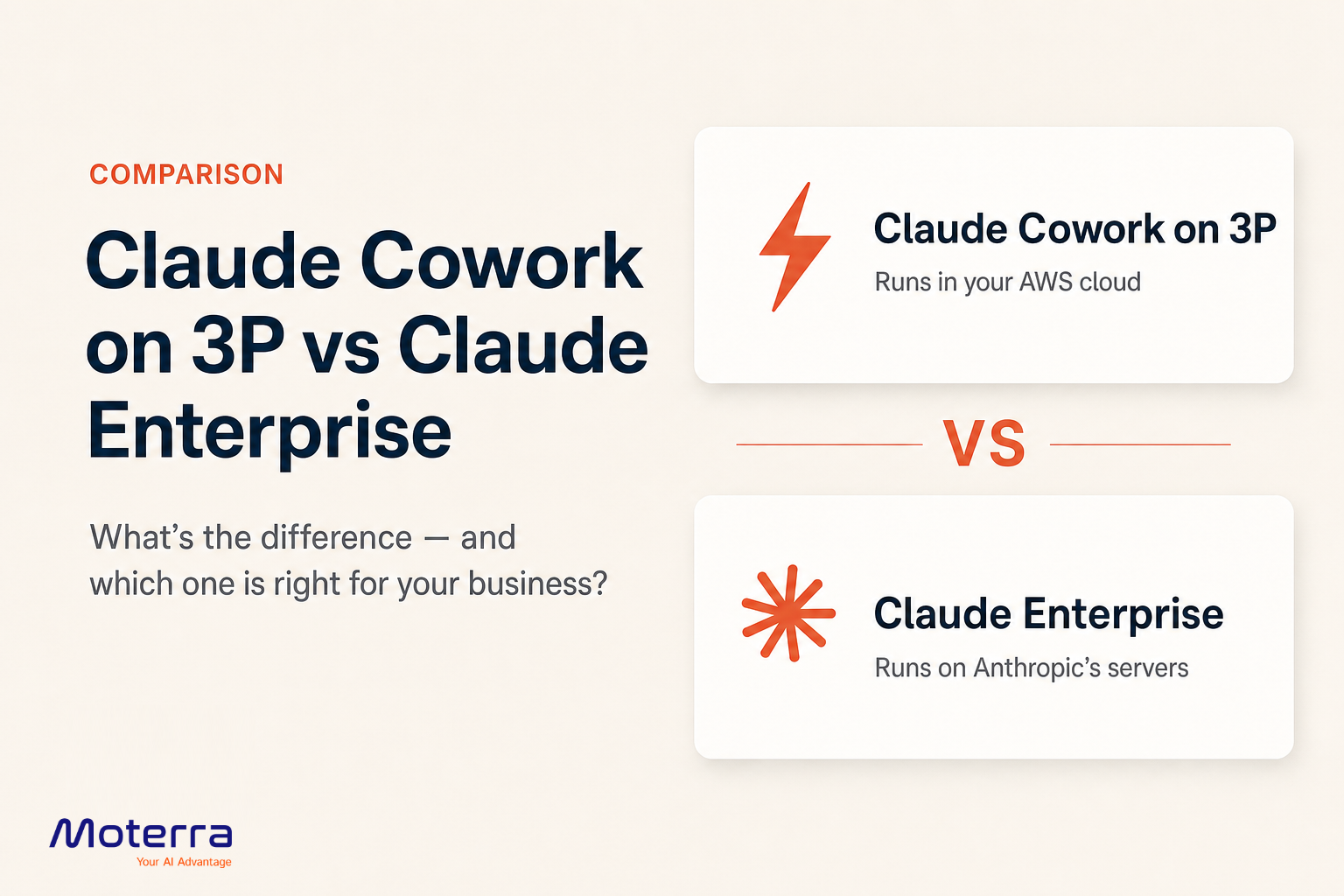
Moterra, as a European AI company, offers an alternative to US-headquartered AI vendors. While underlying infrastructure may be provided by global cloud vendors, the combination of UK/EU data residency, customer-controlled encryption, and European company governance ensures you maintain the same data control as your existing document management systems.
Customer-Controlled Encryption and Access
Your organisation holds the cryptographic keys that encrypt all data. The infrastructure provider cannot decrypt your content even with physical access to servers. This creates technical enforcement of confidentiality: even if compelled by legal process, the provider cannot surrender intelligible data without your cooperation.
Role-based access controls ensure solicitors see only matters appropriate to their role. Audit trails log every query and response, supporting privilege reviews, demonstrating compliance, and detecting potential misuse.
Network Architecture and Security Layers
Private deployment implements multiple security layers: network isolation within your firm’s security perimeter, zero-trust architecture requiring continuous authentication, data loss prevention monitoring, and integration with existing backup procedures.
The “Donna” Concept: Institutional Memory for Every Solicitor
Think of securely-deployed AI as providing every solicitor with their own “Donna”—the omniscient assistant from legal television drama Suits who instantly knows every detail of every past matter. This institutional memory transforms junior solicitor capability, prevents reinvention of wheels, and captures senior partner expertise.
AI provides Donna’s perfect memory to every solicitor in your firm—instant recall of every case, every precedent, every detail, available simultaneously across all practice areas.spending two hours searching the DMS, they query the AI: “Show me the arguments we used in the Henderson redundancy case, particularly around selection criteria.”
The AI searches the firm’s DMS, identifies the Henderson matter folder, reviews the defence statement, skeleton argument, and counsel’s advice, then synthesises:
“In Henderson v TechServe Ltd (2023, ET claim 2301847), the firm successfully defended redundancy selection on three grounds:
- Objective scoring matrix applied consistently (citing Williams v Compair Maxam [1982] ICR 156)
- Consultation period exceeded statutory minimums with documented alternatives
- Selection pool definition based on business requirements supported by witness evidence
The tribunal particularly noted evidence that scoring criteria directly related to business requirements—see judgment paragraphs 47-52. Partner notes indicate opposing counsel tried but failed to establish pool definition issues by comparing with Capita Hartshead Ltd v Byard [2012] ICR 1256, but we distinguished that case based on…”
The response includes clickable links to actual documents in the DMS and specific paragraphs referenced. The solicitor reviews source materials directly, verifies relevance, and adapts the approach—all within 15 minutes rather than two hours.
Time savings: 1.75 hours per query
Accuracy improvement: 100% verified citations from actual firm work
Knowledge transfer: junior solicitor accessing senior partner expertise without interrupting billable work
Application 2: “Draft a settlement agreement using the confidentiality clause from the Smith case”
A commercial solicitor needs to document a settlement reached in a supplier dispute. The client emphasises confidentiality, and the solicitor recalls a previous matter involved an especially robust confidentiality provision.
They query: “Draft a settlement agreement for the Thompson supplier dispute using the confidentiality clause from the Smith case.”
The AI retrieves the firm’s standard settlement agreement template, locates the Smith matter, extracts the specific confidentiality clause, reviews the current matter file, then generates a first draft. The confidentiality provision comes directly from proven language, pre-tested through actual negotiation. The agreement follows firm house style and structures terms consistent with past successful settlements.
The solicitor reviews the draft, makes matter-specific adjustments, and has a client-ready document in 20 minutes rather than 90 minutes.
Time savings: 70 minutes
Quality improvement: using battle-tested language rather than generic templates
Consistency: maintaining firm standards across all settlement agreements
Additionally, the AI flags: “Note: The Smith confidentiality clause includes liquidated damages provisions negotiated at £50,000. Consider whether appropriate for this matter and adjust amount based on matter size.”
Application 3: “Review this supplier agreement and flag any liability caps below our standard”
An in-house legal team uploads a supplier agreement and queries: “Review this agreement and flag any liability caps below our standard, unusual indemnity provisions, and termination rights weaker than our template.”
The AI analyses the agreement, compares it against company standard supplier terms, and reports:
Liability Cap Issues: Clause 8.2 caps total liability at £100,000. Your standard requires minimum £500,000 for this contract value (£2.3M over three years). Recommend negotiating increase or obtaining Commercial Director approval for deviation.
Indemnity Concerns: Clause 9.4 contains mutual indemnification but excludes consequential loss. Your standard terms include consequential loss in supplier indemnity for data breaches. Given this agreement involves processing customer data (SOW Section 3), recommend including consequential loss for data breach scenarios.
Termination Rights: Clause 12 requires 90 days’ notice for convenience termination. Your standard is 60 days. Acceptable variation if commercial team confirms longer notice period necessary for supplier commitment.
Limitation Period: Clause 8.5 limits claims to 12 months after breach discovery. Your standard is 24 months. Recommend negotiation.
The report includes direct links to specific clauses in the supplier agreement and corresponding provisions in company standard terms. The lawyer reviews flagged issues and negotiates amendments—all within 15 minutes instead of 45 minutes for initial review alone.
Time savings: 30 minutes per contract × 20 contracts quarterly = 40 hours per year per lawyer
Consistency: every contract checked against same standards without fatigue
Risk reduction: unusual provisions systematically identified rather than potentially missed
Cumulative Impact
These applications represent daily solicitor tasks that AI handles efficiently while maintaining confidentiality. A 20-solicitor firm saving 2 hours per solicitor per day gains 40 billable hours daily—approximately 9,600 billable hours annually. At £200 average billing rate, this represents £1,840,000 in additional billing capacity.
Implementation: From Pilot to Practice-Wide
Moterra deployment is designed for simplicity, not lengthy IT projects. Most firms go live in under a week with full onboarding support.
Two Deployment Approaches:
Fast-Start (Under 1 Week): Deploy across your entire firm immediately with Moterra’s guided onboarding:
- Day 1: Infrastructure setup in your cloud environment
- Days 2-3: Integration with your DMS (iManage, NetDocuments, SharePoint)
- Days 4-5: Team training sessions (hands-on, practice-area specific)
- Day 6+: Live usage with ongoing support
Moterra provides dedicated onboarding, training materials, and change management support—not just a subscription and documentation. You get hands-on implementation assistance ensuring successful adoption.
Staged Rollout (4-8 Weeks): Start with one practice area, prove value, then expand:
- Weeks 1-2: Single practice area pilot (3-5 solicitors)
- Weeks 3-4: Refine based on feedback, expand to 2-3 more practice areas
- Weeks 5-8: Practice-wide rollout with lessons learned
This approach builds internal champions, documents success stories, and reduces change resistance—ideal for firms wanting proof before full commitment.
What You Get from Moterra:
- Dedicated onboarding sessions tailored to your firm
- Hands-on training for solicitors (not generic AI tutorials)
- Change management support and adoption best practices
- Usage analytics showing value from day one
- Ongoing monthly strategy sessions (Business/Enterprise plans)
Moterra doesn’t just provide software—we support successful adoption through partner engagement strategies, training materials, and ongoing optimization reviews. Most firms see measurable productivity improvements within the first two weeks of deployment.
Security, Compliance & Risk Management
Secure AI deployment requires comprehensive attention to information security, regulatory compliance, and risk management.
ISO 27001 Alignment: Private AI infrastructure should align with ISO 27001 information security management standards, including documented security policies covering access controls, encryption, network security, incident response, and business continuity.
GDPR Compliance: Conduct a Data Protection Impact Assessment documenting what personal data the AI processes, how it’s processed, security measures, risks to data subject rights, and mitigation measures. The DPIA demonstrates professional diligence and satisfies ICO expectations.
SRA Professional Obligations: Private deployment with customer-controlled encryption, UK/EU data residency, audit trails, and role-based access controls provides technical enforcement of confidentiality obligations. Document these measures in your firm’s information security policy.
Role-Based Access Controls: Implement granular access controls matching firm structure—practice area segregation, matter-level permissions for sensitive matters, experience-based access, and regular audit trail review.
Encryption and Key Management: Encrypt data at rest, in transit, and during processing. Customer-controlled encryption keys ensure your firm holds ultimate ability to decrypt data. Implement proper key management in hardware security modules with documented key rotation procedures.
Incident Response: Document incident response procedures covering detection, notification (internal/external), investigation, and remediation. GDPR requires breach notification within 72 hours when personal data breaches risk individual rights.
Third-Party Vendor Assessment: Conduct thorough due diligence on infrastructure providers: security certifications (ISO 27001, SOC 2), data residency commitments, encryption capabilities, and contractual liability provisions.
The Business Case: ROI for UK Firms
Moterra’s Transparent Pricing
Moterra offers transparent, accessible pricing for all firm sizes:
- Team Plan: £500/month (up to 50 users) = £10/user
- Business Plan: £1,300/month (up to 200 users) = £6.50/user
- Enterprise: £2,500/month (unlimited users)
- Plus Infrastructure: £5-8/user/month
Total: £11-18/user/month
Market Context:
Legal AI platforms typically charge £80-320 per user monthly, often with opaque pricing requiring lengthy sales negotiations. Moterra’s transparent model makes secure AI accessible to firms of all sizes.
ROI Calculations
Solicitors save approximately 2 hours daily through AI-assisted research, drafting, and review.
20-solicitor firm:
- Annual Moterra cost: £17,280
- Hours saved: 9,200/year (value: £1,840,000 at £200/hour)
- ROI: 106x | Payback: 3.4 days
5-solicitor boutique:
- Annual Moterra cost: £6,420
- Hours saved: 2,300/year (value: £460,000 at £200/hour)
- ROI: 71x | Payback: 5 days
Beyond Time Savings:
- Reduced citation errors and professional indemnity risks
- Template consistency across all work product
- Competitive advantage in client pitches
- Accessible pricing for mid-tier and boutique firms
The business case shows payback in under a week with substantial ongoing returns.
IT directors ready to explore secure AI deployment, several concrete next steps begin the journey.
Getting Started
The biggest barrier to AI adoption isn’t technology—it’s overthinking it.
Most firms delay AI deployment for months: conducting feasibility studies, forming committees, planning extensive rollouts, negotiating complex contracts, and requiring significant upfront investment. By the time they’re ready to start, the competitive landscape has shifted again.
Moterra eliminates these barriers. No lengthy planning process. No massive initial investment. No long-term commitment. No complex project management.
The simple path:
Visit Stand D05 at British Legal IT Forum (10 March 2026)
- See live demonstrations of the three prompts discussed in this white paper
- Review the technical architecture and security model
- Ask your toughest questions about integration, encryption, and compliance
- Get transparent pricing specific to your firm size
If it makes sense, start within a week:
- Infrastructure setup in your cloud environment (Day 1)
- DMS integration (Days 2-3)
- Team training (Days 4-5)
- Live usage (Day 6+)
That’s it. You’re operational with full onboarding support, not navigating complex implementation alone.
Then expand as you see value:
Once solicitors experience the benefits—instant precedent access, template-based drafting, contract review automation—you can build from there. Custom AI agents for specific practice areas. Automated workflows for recurring tasks. Advanced integrations with your unique systems.
But none of that requires upfront commitment. Start with the core platform. Prove value in the first week. Expand when—and only when—you’re ready.
The most important thing is to start.
Moterra’s accessible pricing (£11-18/user/month), transparent terms, rapid deployment, and hands-on support mean there’s no reason to delay. The firms gaining competitive advantage today aren’t the ones with the most elaborate AI strategies—they’re the ones who started.
Contact:
- Visit: Stand D05, British Legal IT Forum
- Email: [email protected]
- Phone: +44 79 2551 5710
- Web: https://moterra.ai/industries/legal-ai