
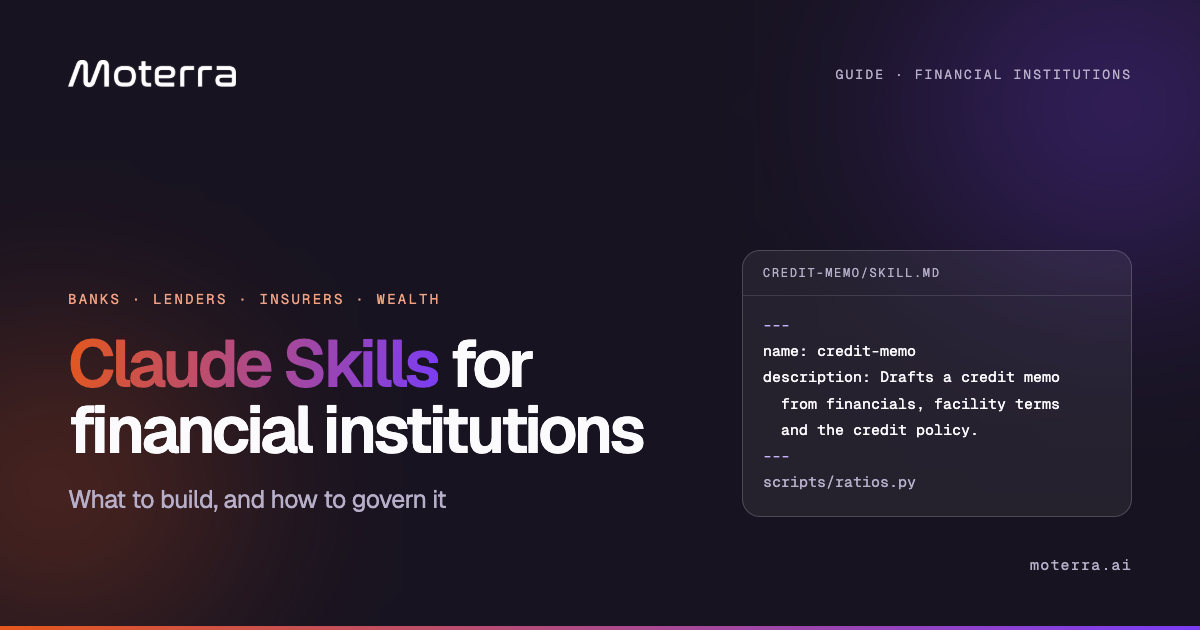
Financial institutions already run on written procedures: how a credit memo is built, what a suitability report must contain, what a complete KYC file looks like. Claude Skills turn those procedures into something Claude follows the same way every time, with the rule and the source cited at each step.
This guide is for banks, lenders, insurers, wealth and asset managers. It covers which skills to build by business line, one worked example, the controls a regulator will expect, and where the model should run.
A Claude skill packages a procedure, its checklist and its calculations into a folder Claude loads when the task matches. In a financial institution the best first skills are high-volume procedures with a written standard: credit memos, KYC file checks, complaint responses, suitability reports, promotion reviews and underwriting triage. Each skill drafts; a named person decides. Skills need an owner, a test set and a review date, and the model they run against should sit where your outsourcing and data rules allow, often your own AWS or Azure account.
What a skill is, in a financial institution's terms
A skill is a procedure manual, its checklist and its calculator, in one folder.
Anthropic introduced Skills in October 2025. Each skill has a SKILL.md file with a name, a description and the steps, plus optional reference files, such as a credit policy or a rule checklist, and scripts for anything that must be exact. Claude reads only the short description until a request matches, then loads the full procedure. A desk can hold dozens of skills without any of them getting in the way.
Why skills fit regulated finance
Four properties make skills a better fit for regulated work than prompts or chat.
Skills, Projects and connectors: three layers
Skills are one of three things that turn a Claude licence into a working tool. Each answers a different question.
| Projects | Connectors and retrieval | Skills | |
|---|---|---|---|
| Answers | What does this team know? | Where is the data? | How do we do this task? |
| What it holds | Standing instructions and documents for one team or client | Links to live systems through MCP, and search over document libraries | A procedure, its checklist, templates and scripts |
| Loaded | Inside that project | When a tool is called or a document is retrieved | Only when the task matches |
| Example | A Credit Risk project with the credit policy and sector notes | FactSet, the loan file in SharePoint, the KYC record in SQL | Draft the credit memo in committee format |
Put simply, Projects provide the context, connectors provide the data, and Skills provide the method. A credit analyst working in the Credit Risk project asks for a memo; a connector pulls the financials; the credit memo skill decides how the memo is built. Remove any one layer and the output falls back to general knowledge.
For internal documents, retrieval means Claude searches the firm's own policies, precedents and procedures and quotes the passage it relied on, so a question such as "what does our standard facility agreement say about change of control?" is answered from the document, not from memory. For live systems, an MCP server acts as a permission-scoped bridge: Claude can query the CRM or the loan system, and where configured take an action, only within the user's role.
What Anthropic built for financial services
In July 2025 Anthropic launched Claude for Financial Services, a Financial Analysis Solution aimed at analysts, researchers and investment teams.
The solution brings market feeds and internal data into one interface, with every claim linked back to its source document for verification. It combines four parts:
The data connectors
Anthropic lists the target workflows as due diligence and market research, competitive benchmarking and portfolio deep dives, financial modelling with full audit trails, investment memos and pitch decks, and portfolio monitoring. On data, it states that by default customer data is not used to train its generative models. Claude for Enterprise and the solution are also available through AWS Marketplace, so procurement can run through an existing AWS agreement.
What institutions have reported
AIG said its early rollouts compressed the timeline to review business by more than five times, while data accuracy rose from 75% to over 90%.
AIG, via AnthropicBridgewater's AIA Labs used Claude for the first versions of its Investment Analyst Assistant, generating Python code, building visualisations and iterating through financial analysis.
Bridgewater AIA Labs, via AnthropicCommonwealth Bank of Australia describes its Anthropic partnership as central to work on fraud prevention and customer service. The pattern across all three is the same: the model is strong on its own, and the gains come when it is pointed at the firm's data with a defined method. That method is what a skill encodes.
Skills by business line
The strongest candidates have weekly volume, a written standard and a qualified reviewer at the end.
Banking and lending
Retail, wealth and advice
Insurance
Markets, research and asset management
Compliance and risk
A worked example: the credit memo skill
What a credit memo skill looks like on disk:
The script calculates leverage, interest cover and debt service cover the same way on every file. The policy file holds the limits. Claude drafts the narrative, flags exceptions against the policy and stops short of a recommendation. The credit officer gets a consistent first draft; the committee gets a memo where every number can be traced.
Connecting skills to internal data
A skill supplies the method. The data arrives through connectors.
The market data connectors above cover the research desk. The procedures in this guide also need the institution's own records.
Internal systems matter as much: the loan file in SharePoint, the KYC record in a SQL database, the complaint in the case system. Moterra AI Bridge connects these, and connectors inherit the permissions already in place, so a person sees exactly what they could already see.
Why most rollouts stall, and where skills fit
Buying licences gives staff access. It does not change how the institution works.
A common picture: seats bought, a few enthusiasts using Claude daily, and little else changed. Three gaps explain most of it.
The order matters. Discovery comes first: which workflows cost the most senior time, what data exists, and which regulatory and information-security constraints apply. Regulated constraints such as information barriers, data scoping and audit trails are designed into the architecture at that stage, not added after the build. Skills sit at the centre of the configuration layer, because they are where the institution's own procedures live.
The controls a financial institution needs
A skill runs code on client data. Six controls make it defensible.
Where the model runs
The skill is the same everywhere. What changes is who processes the data.
| Anthropic-hosted plan | Your own cloud | |
|---|---|---|
| Model runs in | Anthropic's infrastructure | Your AWS or Azure tenant, your chosen region |
| Skills reach staff by | Upload or admin provisioning | MDM, by identity provider group |
| Audit trail | Admin console, Compliance API | CloudTrail or Azure Monitor, into your SIEM |
| Encryption keys | Anthropic | You, via KMS or Key Vault |
Outsourcing rules in SYSC 8, PRA SS2/21 on outsourcing and third-party risk, and DORA for EU entities all ask who processes the data, where, and how the firm exits. Running Claude in the institution's own AWS or Azure account keeps processing inside a cloud relationship that has already been through that review.
That is what Private Claude Cowork by Moterra deploys: Claude Desktop and Cowork configured against your own tenant, skills delivered as Cowork Plugins by identity group, and connectors through Bridge. Moterra manages the deployment; it does not host the data. More on the regulatory side in Deploying Claude under GDPR and DORA.
The first 30 days
Start with three skills in one business line, and prove them before scaling.
After a month the institution has three tested, owned skills and a repeatable approval route for the next ones.
Frequently asked questions
What are Claude Skills?
Claude Skills are folders containing a SKILL.md file of instructions, plus optional scripts, templates and reference documents. Claude reads each skill's short description up front and loads the full procedure only when a task matches. For a financial institution, a skill is a written procedure, its checklist and its calculations, packaged so Claude applies them the same way every time.
Which skills should a bank or insurer build first?
Procedures with weekly volume, a written standard and a named reviewer: credit memo drafting, KYC file completeness checks, complaint final responses, suitability report drafting, financial promotion review and underwriting submission triage. Each produces a draft for a qualified person to approve.
Can Claude Skills make regulated decisions?
A skill should not. The right design produces a draft, a check or an evidence pack, and states in the skill that approval stays with the accountable person, whether an adviser, underwriter, credit officer, MLRO or compliance. That keeps accountability where the Senior Managers and Certification Regime places it.
How do Claude Skills fit model risk management?
Treat each skill as a governed tool: a named owner, version control, a test set of real cases, and a review date. Scripts that calculate figures should be tested like any other end-user computation. Firms applying PRA SS1/23 typically record material skills in the same inventory as other models and tools.
How do skills respect information barriers?
Through assignment and permissions. Skills and connectors are provisioned by identity provider group, so each side of a SYSC 10 barrier gets its own set, and connectors inherit the permissions already in place. Every model call is logged against the named user.
What is Claude for Financial Services?
Anthropic's Financial Analysis Solution, launched in July 2025. It pairs Claude for Enterprise and Claude Code with expanded usage limits, pre-built MCP connectors to providers including FactSet, S&P Global, PitchBook, Morningstar, Daloopa, Box, Databricks and Snowflake, and implementation support. Customer data is not used for model training by default.
Can financial institutions run Claude Skills in their own cloud?
Yes. Skills are files read by the client, so they work in Claude Desktop and Cowork configured against Claude on Amazon Bedrock or Microsoft Foundry in the institution's own account. Model calls stay in that tenant and region, which is how many firms meet outsourcing expectations under SYSC 8, PRA SS2/21 and DORA.
What results have financial institutions reported with Claude?
Anthropic cites AIG compressing its business review timeline by more than five times in early rollouts, with data accuracy rising from 75% to over 90%, and Bridgewater's AIA Labs using Claude for the first versions of its Investment Analyst Assistant. Anthropic also reports Claude Opus 4 scoring 83% accuracy on complex Excel tasks in a FundamentalLabs agent.
Sources · Anthropic Skills announcement · Claude docs, Agent Skills overview · Anthropic, Claude for Financial Services · Vals AI Finance Agent benchmark · FCA Handbook COBS 4, COBS 9, DISP 1, SYSC 8, SYSC 10 · PRA SS1/23, SS2/21 · Money Laundering Regulations 2017 · Checked 28 Sep 2026
 Moterra
Official Anthropic partner. Deploys Claude inside companies' own AWS and Azure tenants.
Moterra
Official Anthropic partner. Deploys Claude inside companies' own AWS and Azure tenants.