
I’m Eglė, CFO at Moterra. In my previous post, I mapped where major AI solutions position themselves on capability versus control. Now I’m trying to understand a bigger question: what approach actually works for businesses trying to implement AI successfully?
Let me share what I’m seeing and try to make sense of why the platform approach often falls short.
The Platform Promise (And What I'm Noticing)
Most businesses start their AI journey by evaluating platforms. The logic seems sound: pick a solution, deploy it, and start getting AI benefits across the organization.
Microsoft Copilot offers security and business context integration. It works within your existing Microsoft environment, which feels safe and familiar. But everything is as Microsoft decided, you can’t adjust features, customize workflows, or modify how it handles your specific business processes.
ChatGPT Enterprise provides more customization options and powerful AI capabilities. But you’re integrating your business data with an external platform where you don’t control the underlying infrastructure or data handling.
Both approaches treat AI as software you buy and deploy, rather than a capability you develop for your specific business needs.
The Startup Flood (What I'm Observing)
Every day, dozens—maybe hundreds—of new AI startups launch. Most follow the same pattern: founders, often in their twenties, looking to build scalable platforms and become the next unicorn.
The business model is predictable: create a generic AI tool, add some enterprise features, scale quickly, and capture market share. Nothing wrong with this approach from an investment perspective, but I’m not convinced it solves the real business problem.
What Businesses Actually Need
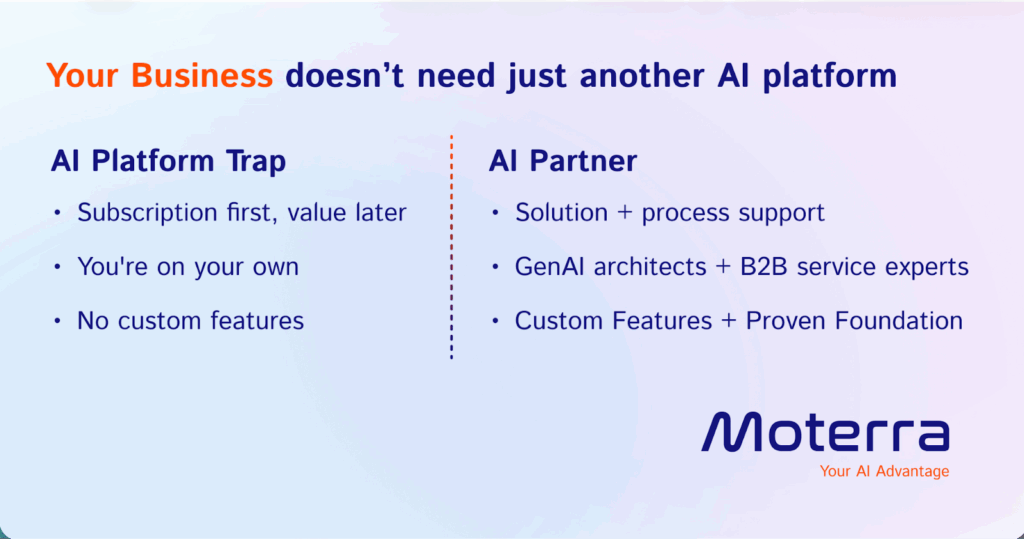
Here’s what I’m learning from working with companies implementing AI: they don’t need another platform subscription. They need a partner who understands their business, their value chain, and how AI can best serve their specific operations.
Real AI implementation requires:
Business Understanding: Someone who can map AI capabilities to your actual workflows and processes, not just provide generic tools.
Tailored Solutions: Implementations that work with your existing systems and data structures, adjusted to your specific needs.
Ongoing Support: Continuous optimization and adjustment as your business learns what works and what doesn’t.
Knowledge Transfer: Helping your team understand not just how to use AI tools, but how to think about AI integration strategically.
The Economics: What I'm Seeing
The difference comes down to where companies focus their energy and resources.
Startup Economics: Launch SaaS products, raise funding rounds, burn money on marketing to scale quickly, and inflate valuations. The focus is on rapid growth and investor returns.
Business-Focused Economics: Build solid solutions, invest time in understanding client relationships, and create real value for specific business needs. The focus is on sustainable value creation.
Since AI emerged during the “everyone wants to be a unicorn” era, finding companies that take the harder path isn’t simple. You need organizations that have not just AI foundations and solutions you can build on, but also the experience and willingness to listen to business needs and respond accordingly.
I know this sounds old-fashioned, but I believe there are businesses out there that understand this approach.
The Partnership Approach
This is where the partnership model becomes valuable. Instead of selling you a platform subscription, a true AI partner works with you to:
- Analyze your specific business processes and identify where AI adds the most value
- Provide foundational solutions that can be tailored to your needs
- Offer ongoing support and optimization as your requirements evolve.
- Transfer knowledge so your team can make informed decisions about future AI investments.

At Moterra, we’ve built our AI Business Suite as a foundation with intelligent agents that we can adjust and tailor for specific business needs. The suite serves as a solid base that makes developing any additional solutions much faster and more efficient. I’m naturally biased toward our approach, but the business logic makes sense.
My Takeaway
Most businesses don’t need another AI platform, they need an AI partner who understands their specific challenges and can build solutions accordingly.
The platform approach works for vendors who want to scale quickly, but it often leaves businesses with generic tools that don’t quite fit their actual needs. Real AI value comes from understanding how the technology can enhance your specific business processes.
The fundamental question isn’t about features or pricing, it’s about whether you’re getting a solution built for your business or just another subscription.